
In engineering plastic part development, especially in automotive, medical and electronics programmes, prototypes are often validated using materials different from the production material. At first glance this looks efficient: lower cost, faster delivery and easier processing. From an engineering standpoint, however, it is one of the decisions that introduces the most errors into later project phases.
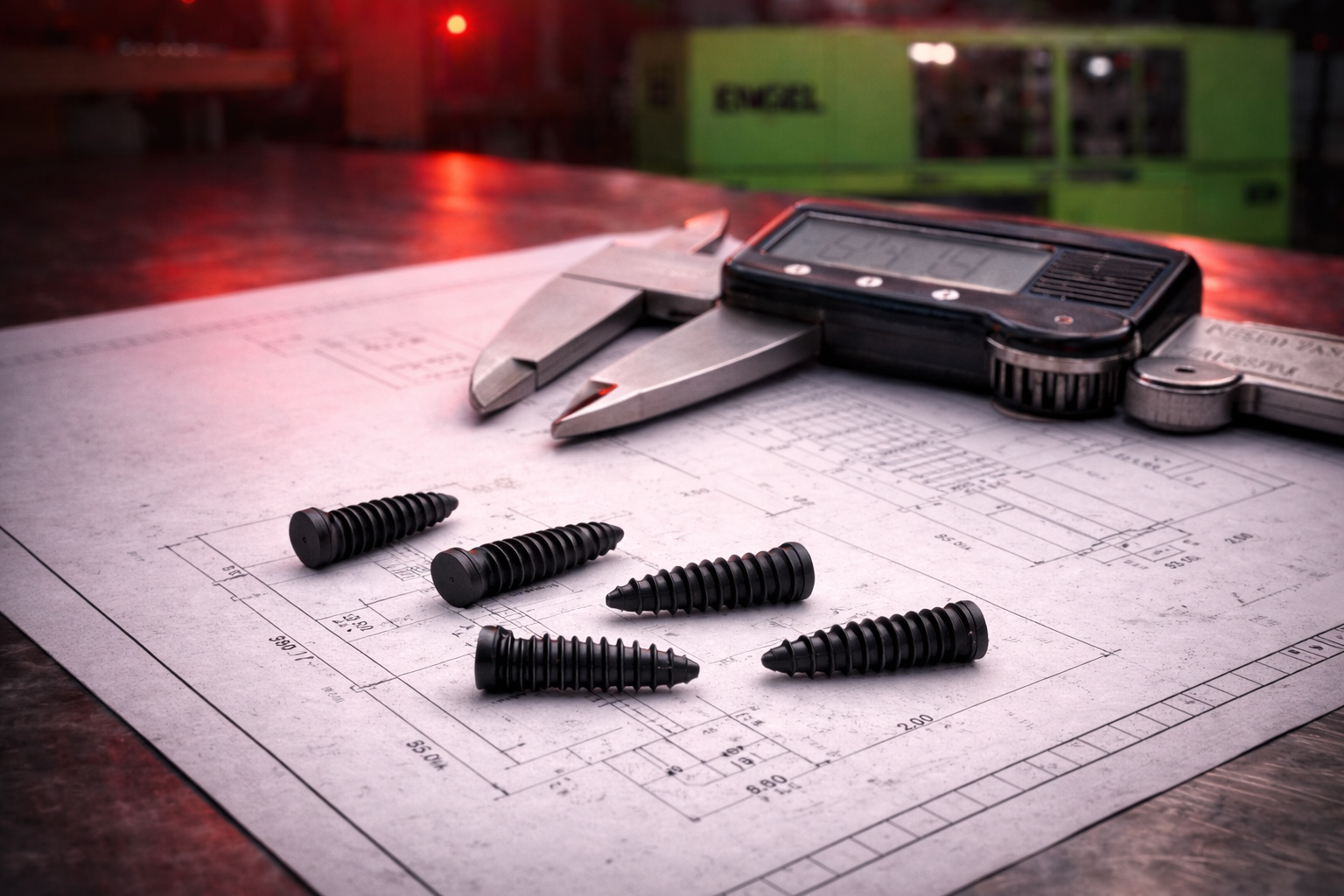
What happens when you validate with a different material
1. Shrinkage is not transferable
In materials such as PA66 GF30 or PPS GF40, shrinkage depends on fibre orientation, moulding conditions and part geometry. This real anisotropic behaviour does not exist in the same way in ABS, resins or printed materials.
Result: incorrect tolerances, assembly deviations and design decisions based on data that does not represent future production.
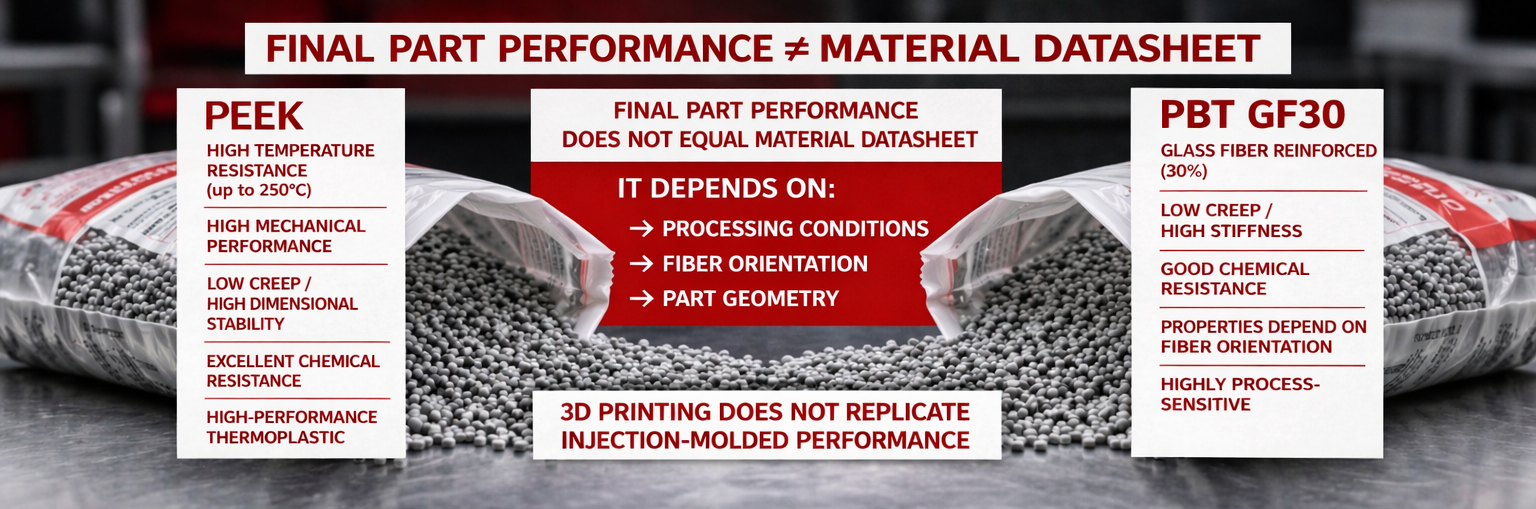
2. Mechanical behaviour changes completely
A substitute-material prototype does not reproduce real stiffness, does not reflect fatigue strength and does not simulate creep at temperature. In PEEK, PPS GF40 or glass-filled PA66, these properties depend directly on the material grade and injection moulding process.
In other words, you validate something that will not exist in production.
3. Real requirements cannot be validated, including compliance
In regulated sectors, consistency between prototype and final product is part of technical risk. In medical programmes, validation is tied to material through biocompatibility or sterilisation; in automotive, OEM specifications are usually fixed; in electronics, dielectric properties may be specific to the polymer and its processing history.
A prototype made in another material can validate form and selected functions, but it should not be assumed representative of properties or requirements that depend on the final material and process.
The common mistake: confusing similar with valid
A material may seem equivalent because it shares one isolated property. But in product engineering, the important question is not partial similarity. It is whether the prototype represents real behaviour.
- ABS can validate shape.
- SLA can validate appearance.
- Neither validates real industrial function when the final part depends on production material.
Real impact on product development
When substitute materials are used for validation, problems appear later: tolerance corrections in pre-series, assembly failures, additional mould iterations and validation delays.
The cost does not disappear: it is moved to the most expensive phase of the project, when production tooling, timing and launch pressure are already in play.
The alternative: prototypes injection-moulded in production material
For material- and process-dependent requirements, the most representative approach is to mould with the intended production grade under documented injection conditions and measure the resulting shrinkage. This requires prototype moulds prepared for engineering plastics, process control and design decisions oriented towards industrialisation.
What changes when this is done properly
When the prototype is injection-moulded in the intended grade, tolerances and mechanical behaviour are more representative. Transfer to series still requires confirmation with the production tool, machine and conditions.
Technical decision summary
Validating prototypes with materials different from the production material creates errors because it does not reproduce shrinkage, mechanical behaviour or the final product's regulatory requirements. Reliable validation requires injection moulding with the specified material grade under industrial conditions.
FAQ
Can an ABS prototype validate a final PA66 GF30 part?
No. ABS does not reproduce the anisotropic shrinkage or mechanical behaviour of glass-filled PA66.
Why is using final production material important in prototypes?
Because final properties depend on the injection moulding process and production material, not only on geometry.
Are 3D-printed prototypes useful for validation?
They are useful for geometric or visual validation, but not for functional or industrial validation.
Which sectors require validation with final production material?
Automotive, medical devices and technical electronics, among others.
Conclusion
If material is part of the product function, it is not a variable that can be simplified. Validating with another material does not reduce risk. It hides it.