
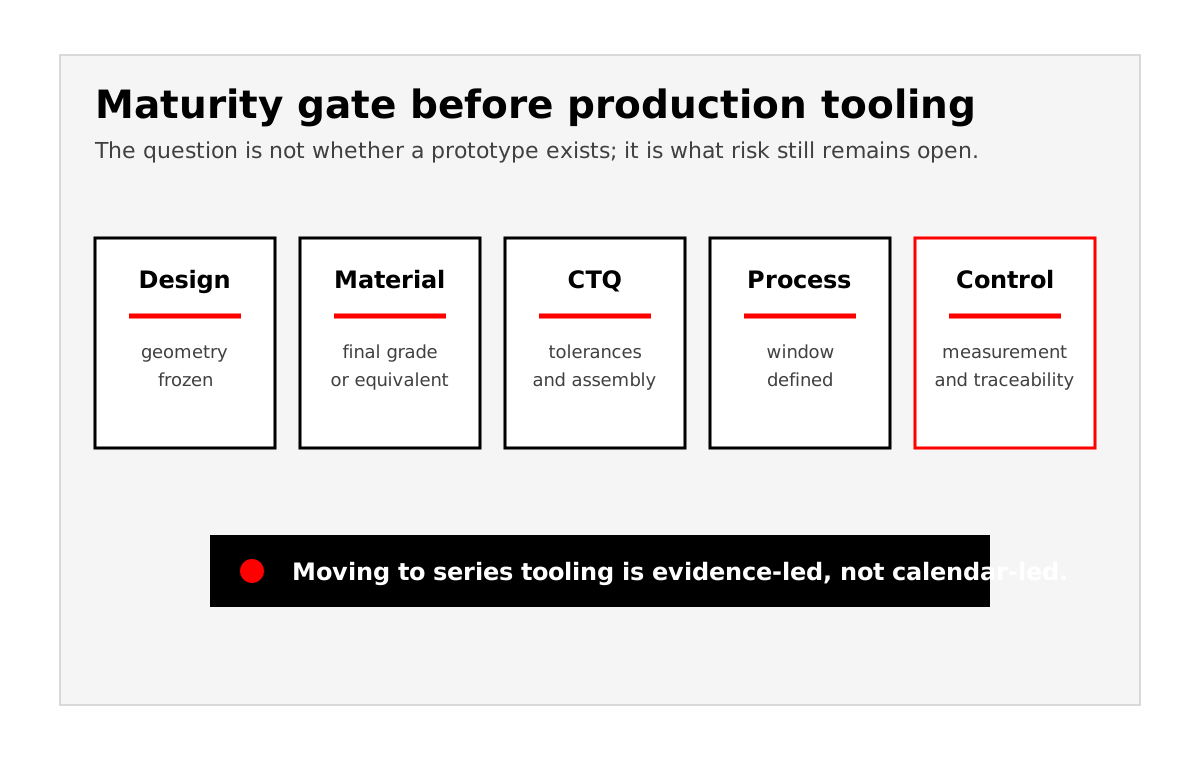
Moving from prototype to production mould should not be a leap of faith. It should be a decision based on frozen design, defined material, measured critical tolerances, understood process behaviour and a prepared control plan.
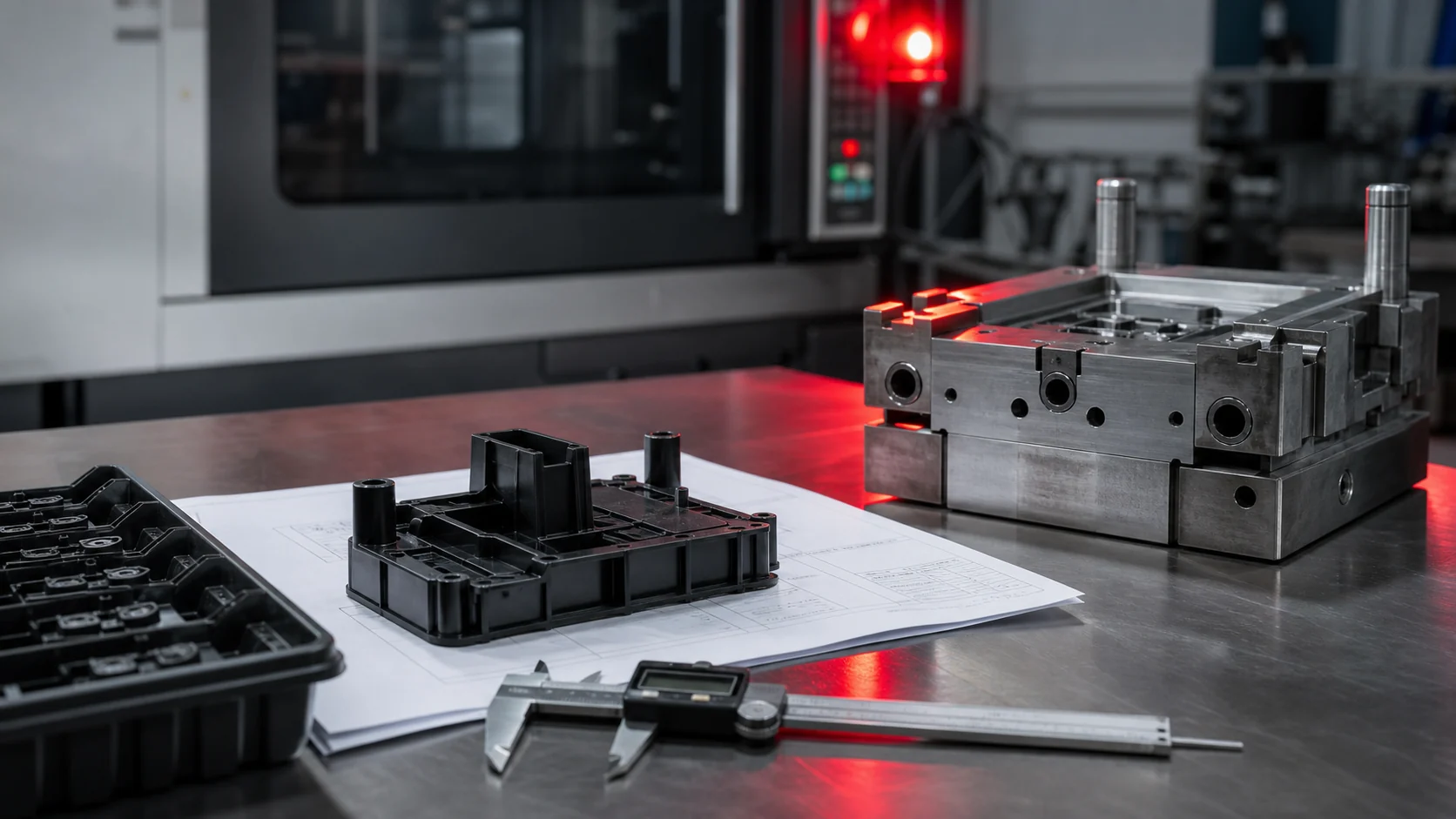
A prototype can confirm that an idea works, but that does not automatically mean the project is ready for definitive tooling. The difference is industrial maturity: how many questions remain open and how many have already been measured with representative parts.
The question is not “do we have a part?”. The right question is: “what have we learned from that part and what risk remains for production tooling?” If the answer still depends on assumptions, the project is not mature. If the main decisions are backed by data, the transition starts to make sense.
Key idea: production tooling should receive knowledge, not uncertainty. The prototype turns technical questions into design, process and control criteria.
1. The design is no longer changing every week
The first maturity signal is that geometry is stable. This does not mean the CAD is perfect; it means pending changes are minor, localised and justified. If wall sections, clips, bosses, ribs, closures or functional zones are still being debated, definitive tooling may freeze an unstable geometry too early.
Before production tooling, the team should know which surfaces are functional, which areas can still be adjusted and which changes should not be made without reviewing shrinkage, warpage, assembly or appearance impact.
2. The final production material is defined or bounded
Material is not an administrative decision. It changes shrinkage, stiffness, appearance, strength, deformation, filling and assembly behaviour. If the prototype was made with a material far from the intended one, it can validate shape but not necessarily process or final performance.
The transition to series is safer when the final grade is defined or when equivalence of the prototype material is documented for the properties evaluated and the limits of extrapolation are stated.
3. Critical dimensions are treated as CTQ
Not every dimension carries the same weight. Some describe the part; others decide function, assembly, sealing, guidance, clipping or interface with another component. Those critical-to-quality characteristics must be identified before moving to production tooling.
A good maturity signal is that the team already knows what to measure, with which method, how often and against which acceptance criteria. If CTQ are not defined, production tooling inherits a discussion that should have been closed earlier.
4. A reasonable process window exists
One good part does not prove that the process is robust. Before investing in series tooling, the useful question is whether there is process margin: whether small changes in temperature, pressure, speed, packing or cooling keep the part within specification.
The objective is not to replicate the full production validation at prototype stage. It is to arrive at definitive tooling with a much more informed process hypothesis: sensitive areas, relevant parameters, likely defects and conditions worth preserving.
5. The control plan starts before definitive tooling
The control plan should not appear at the end, after the first production parts have already been moulded. Prototype measurements can help define which characteristics are controlled, which tests are needed, what evidence is documented and which data should accompany launch.
When the project requires approval, traceability, PPAP, OQ/PQ validation or capability criteria, starting late usually creates rework. Starting from prototype helps the team reach series with a clearer validation route.
Checklist: signals that you can move to series
- The main geometry is frozen and pending changes are minor.
- The final material is defined, or equivalence is justified for the properties evaluated.
- CTQ and critical tolerances are identified.
- Functional assembly has been validated with representative parts.
- Expected injection defects have been reviewed: sink marks, warpage, weld lines and flow marks.
- There is an initial process window or documented process hypothesis.
- The measurement, traceability and control plan is prepared for launch.
When it is better to wait
It is better not to move to production tooling if the prototype is still answering basic design questions, if the material is undecided, if critical tolerances have not been measured or if every iteration changes assembly behaviour. In those cases, waiting is not delaying the project; it is avoiding uncertainty transfer into the most expensive phase.
The practical decision: moving to series makes sense when the cost of continuing to learn with prototypes is higher than the value of the questions still open.
Frequently asked questions
Is customer approval of a prototype enough to launch production tooling?
Not always. Visual or functional approval may be necessary, but it does not replace validation of material, tolerances, process and control.
What happens if production tooling starts too early?
Design or process changes become tooling modifications, new samples, delays and higher correction costs.
Does P2P remove series validation?
No. P2P reduces uncertainty before final tooling, but final validation must use the production tool, equipment and conditions required by the project.
What is the best sign of technical maturity?
Important decisions are based on measured parts, understood defects and clear acceptance criteria, not opinion.
Cross-checked official technical sources
- ISO 9001:2015 - Evidence-based quality management and documented information
- FDA CDRH - Process Validation Module
- FDA - Quality Management System Regulation, effective 2 February 2026
- ISO 14971:2019 - Risk management for medical devices
These sources support the general principles. Applicable acceptance criteria must be defined for the material grade, design, process, sector and agreed requirements.