
A prototype can validate shape and fit, but still fail in manufacturing if draft, wall thickness, ribs, radii and gate strategy are not reviewed.
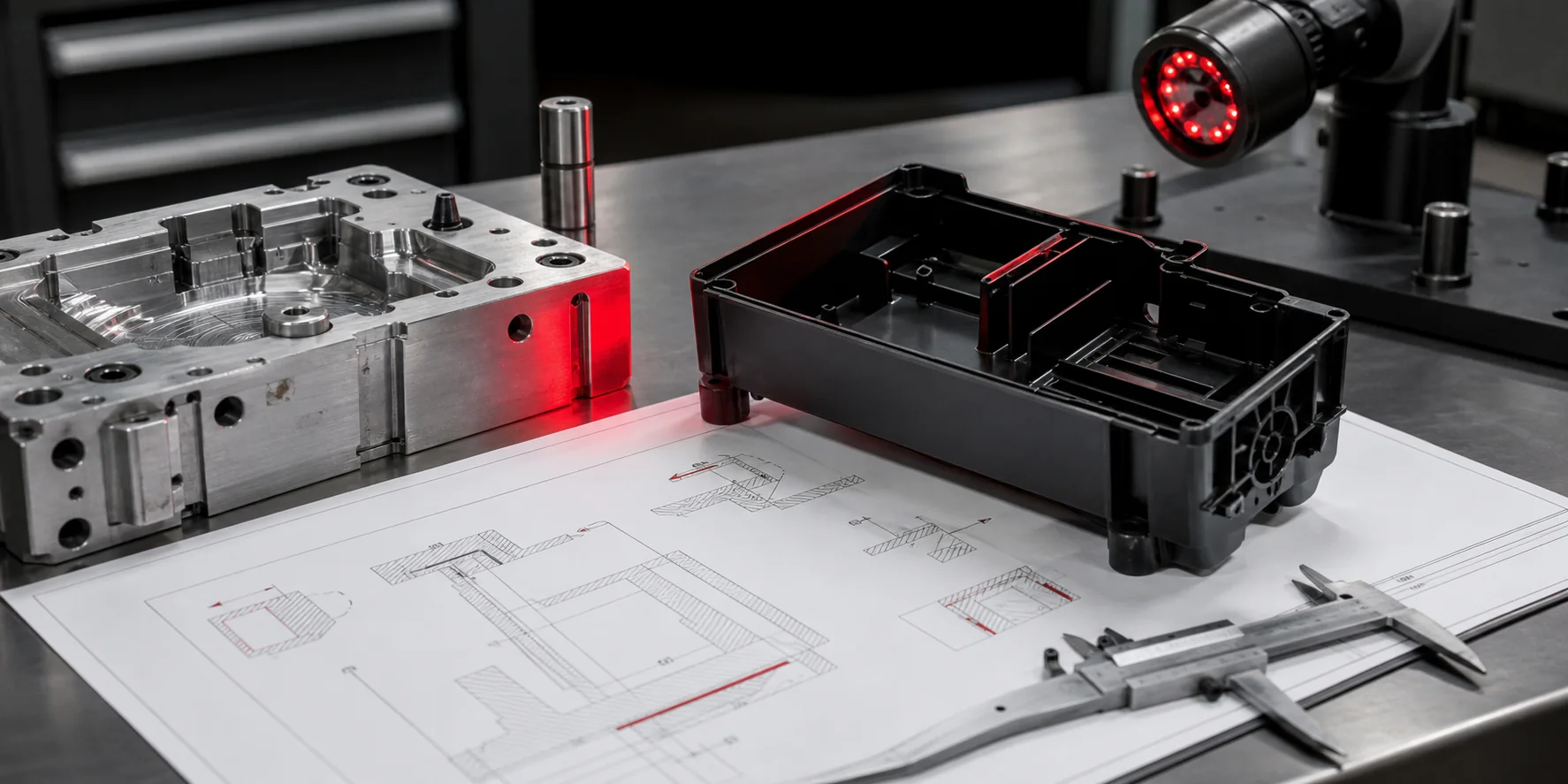
The issue does not show up in the mock-up
A printed, machined or hand-assembled part may fit and meet a basic function. That does not prove it is ready for injection moulding. The process adds draft, wall thickness, ribs, internal radii, sink-prone areas and real access for ejection.
DFM turns those constraints into design decisions before they are fixed in steel. The question is not only whether the product works, but whether it can fill, pack, cool and eject repeatedly with the intended material.
Walls, radii and ribs: read geometry as a process
Abrupt wall changes concentrate mass and alter cooling. They can create sinks, warpage or dimensional variation that a mock-up cannot reveal. A consistent nominal wall, gradual transitions and suitable internal radii make flow and shrinkage more controllable.
Ribs and bosses must add stiffness without creating excessive local sections. An injected prototype shows whether the solution avoids visible marks and retains function, or whether height, thickness, radius or position must change.
Draft and ejection
A surface can be geometrically correct and still block ejection. Draft depends on material, texture, depth and contact area; it is not cosmetic. Without margin, the part can scratch, distort or need an ejection force that compromises stability.
The trial should check ejector support points, retained areas and whether vacuum, texture or a flexible wall changes behaviour. The useful output is a redesign criterion or confirmation that release is stable.
Gate, venting and cooling
Gate location affects flow path, orientation, weld lines, pressure and vestige. Venting and cooling are not late additions: they determine whether the part fills without burns, retains appearance and stabilises dimensions after ejection.
A prototype should record what happens when melt and mould temperature, speed, holding pressure and cycle vary. This distinguishes a geometry issue from one caused by an extreme process condition.
What to validate with the prototype
DFM review should end in measurable evidence, not a generic recommendation list.
- Filling: check distant areas, section changes and weld lines.
- Appearance: review sinks, ejector marks, gate vestige and visible surfaces.
- Dimension: measure functional dimensions after a defined stabilisation time.
- Ejection: confirm demoulding and collection do not distort the part.
- Window: observe whether results hold while parameters vary within a realistic range.
The output must be an industrial decision
The result may be that the part is ready for series production, needs geometry changes or requires a second iteration with documented data. Correcting a radius, rib, draft or feeding strategy in the prototype insert reduces uncertainty before committing production tooling.
DFM does not promise that one trial resolves every industrialisation question. It helps identify which assumptions must be validated with real material and process conditions to make evidence-based decisions.
Frequently asked questions about DFM
Is DFM only a CAD review?
No. DFM checks that the part can fill, pack, cool and eject repeatably with the intended injection process.
Which issues can the prototype reveal that a mock-up cannot?
It can reveal sink marks, wall transition marks, ejection difficulty, problematic gates and process-driven deformation.
When should DFM review happen?
Before production tooling is committed, while radii, ribs, draft, wall thickness or feeding strategy can still be changed.