
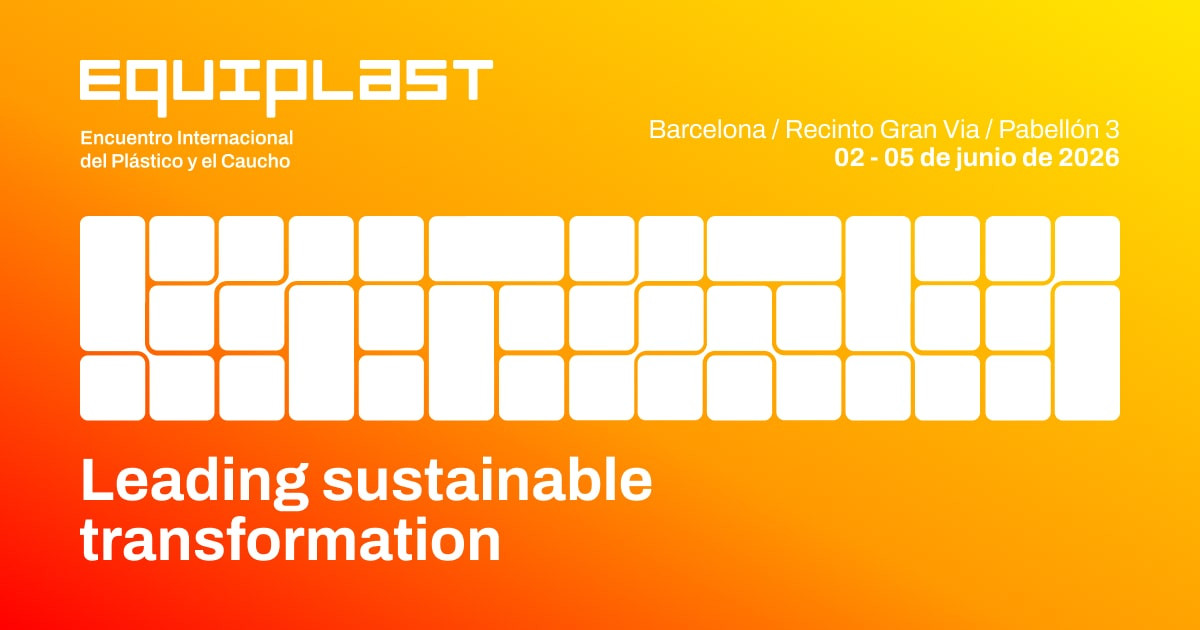
From 2 to 5 June, Fira de Barcelona Gran Via plays host to Equiplast 2026 — the reference trade show for the plastics and rubber industry in southern Europe. With eleven industrial sectors represented, exhibitors including ARBURG, Engel, Wittmann Group, Haitian Ibérica, SEAT and Veolia, and the motto "Leading Sustainable Transformation", the event maps out the key directions redefining the industry: sustainability, digitalisation, energy efficiency and process validation before the production mould.
Equiplast 2026: the plastics sector meets in Barcelona
Equiplast takes place from 2 to 5 June 2026 at the Gran Via pavilion of Fira de Barcelona (Hall 3). It is the largest trade show for the plastics and rubber industry in southern Europe, with representation across eleven industrial sectors: raw materials and additives, transformation machinery, moulds and dies, recycling and environment, automation, measurement and control, among others.
Among the leading machinery and industry exhibitors and partners at the 2026 edition are ARBURG, Engel, Wittmann Group, Haitian Ibérica, SEAT and Veolia — leading names in injection machinery, cell automation, materials and circular economy. This edition's motto, "Leading Sustainable Transformation", concentrates the three axes structuring the programme: sustainability and circular economy, digital transformation and Industry 4.0, and process efficiency.
In the field of mouldmaking and mould components, the event also features ASCAMM (Catalan Association of Mould and Die Manufacturers), Meusburger, Innova Components and HASCO — key references in standardisation, standard components and mould tooling.
Equiplast 2026 includes the Rethinking Plastic Showroom — a space dedicated to products manufactured 100 % from recycled or renewable materials —, the Best in Class Awards for sustainability innovation, guided thematic routes for engineers and procurement managers, and the Equiplast Fest networking event on 4 June to close the show.
What about trends beyond our borders?
Equiplast captures the pulse of the sector in southern Europe, but the same message repeats itself at the major international trade shows. Interplas 2026, held from 2 to 4 June at the NEC in Birmingham with more than 500 exhibiting companies, and the rest of the global circuit all point in the same direction: the plastics industry needs to validate process, material and parameters before committing to the production mould.
The trends defining the sector in 2026
High-efficiency electric machinery
Highlighted trends include the evolution of electric machines, energy efficiency and process control. Specific performance claims should be checked against each manufacturer's official model documentation.
The electrification of injection moulding equipment is consolidating as the standard in new installations due to lower energy consumption per cycle, higher repeatability, reduced hydraulic maintenance and better integration with digital systems.
For process engineering, this has a direct implication: the more repeatable the machine, the more value the parameters documented during prototyping hold, and the more transferable that learning can be to the production mould.
Real-time monitoring and scientific moulding
Scientific moulding — understanding and documenting the process, not only inspecting the part — is an approach used in medical, automotive and precision-electronics applications. Monitoring systems allow the recording and analysis of critical variables from every injection cycle.
The goal is to reduce dependence on manual adjustment and replace it with reproducible data. IQ/OQ/PQ studies, capability indices and parameter traceability are now standard language in high-demand sectors.
This trend reinforces the value of prototyping under real process conditions: obtaining geometrically correct parts is not enough. The prototype must record process conditions so that the production mould has a reliable start-up reference.
Sustainability and recycled materials
The use of PCR and bio-based materials is growing due to regulation, market pressure and sustainability targets. Depending on the grade and supply stream, these materials can show different variability and may require process windows tailored against a virgin reference.
Validating a design with virgin material when the production material will be recycled provides an incomplete picture. Sustainability does not eliminate the need for validation: it makes it more critical.
Automation and cell robotisation
Automated injection cells with robotic extraction, in-line quality control and palletising are no longer viewed solely as efficiency improvements. They also deliver repeatability, traceability and process stability.
What trade shows reveal about the industry's real challenges
Trade shows do not simply display technology. They display the problems the industry is trying to solve.
The message is consistent: the industry needs data before committing to the production mould. It needs to know how the injection process will behave with the actual material, under real conditions, before investing in production tooling.
pilot2plant bridges that gap: plastic parts injection-moulded with final production material, documented process and transferable parameters before the production mould.
How pilot2plant connects with these trends
- Real process validation: the prototype is injection-moulded under industrial conditions — temperature, pressure and cycle time comparable to a production scenario.
- Transferable documentation: deliverables include recorded parameters and a nominal/actual dimensional comparison.
- Final production material: work is carried out with the exact grade the customer will use in production, including recycled or high-performance materials.
- Transition to the production mould: the knowledge generated during prototyping is transferred to the production mould, reducing uncertainty in the most costly phase of the project.
The international validation circuit
The international plastics calendar confirms the same direction: more digitalisation, more traceability, more efficiency and more validation before production.
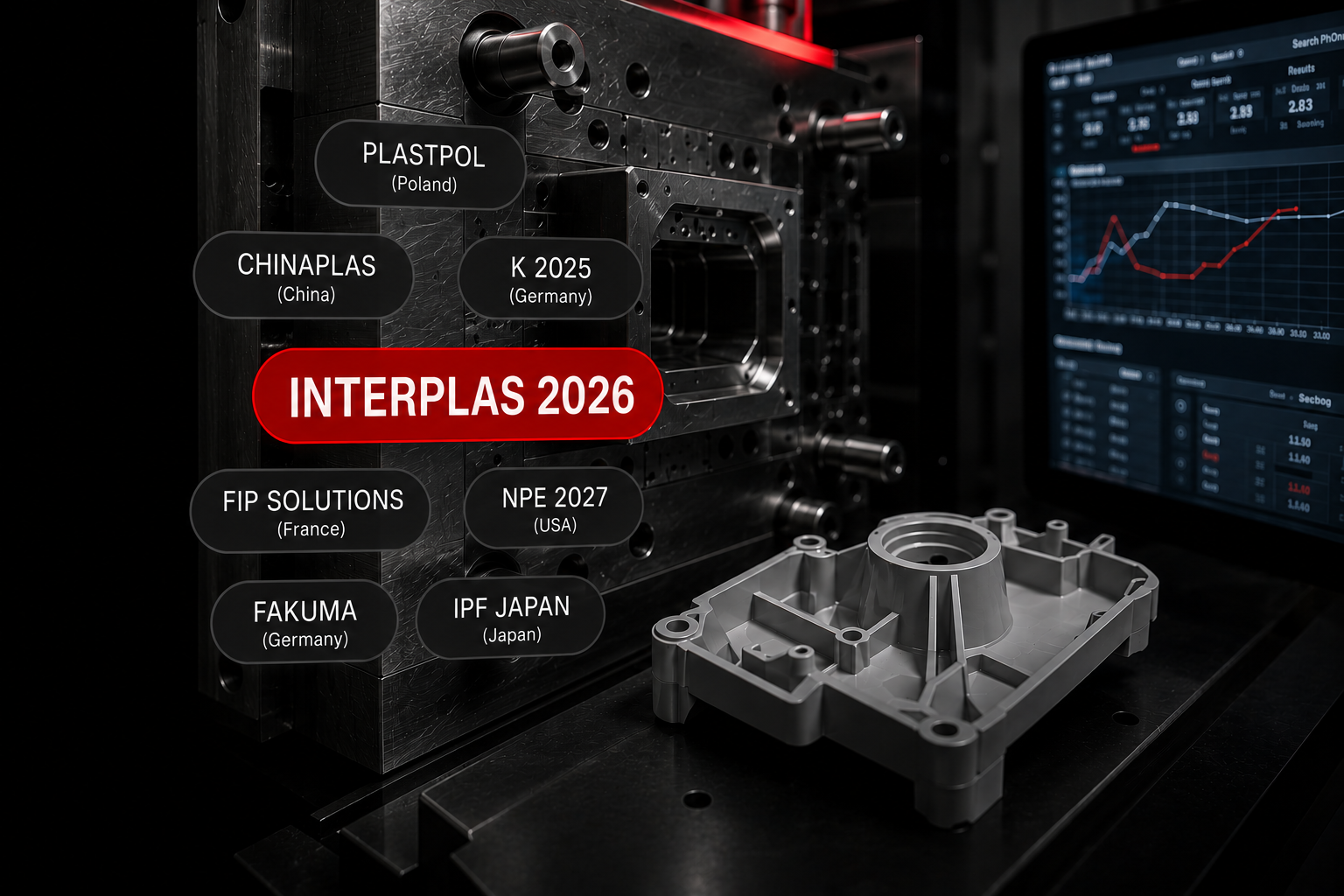
- Plastpol: injection machinery in action and peripheral automation solutions for Central and Eastern Europe.
- Chinaplas: industrial scale, smart manufacturing, automated cells and high-cavity moulds.
- FIP Solutions / France Innovation Plasturgie: technical subcontracting, circular economy and validation for demanding sectors in the French-speaking market.
- Fakuma: process optimisation, tooling, plant digitalisation and energy efficiency.
- IPF Japan: micro-injection, demoulding robotics and high-precision thermal monitoring.
- K Show: global reference in materials, machinery and plastic transformation technologies.
- NPE 2027: automation and process validation for the American market.
Conclusion: from the trade show stand to the production plant
The future of plastics is increasingly intolerant of trial and error on the production machine. Geometric, parametric and material validation before final tooling is a direct way to reduce technical risk, cost and delays.
At pilot2plant we turn that trend into operational reality: validate parts with final production material, real process and useful data before manufacturing the production mould.
Frequently asked questions
When and where is Equiplast 2026 held?
Equiplast 2026 takes place from 2 to 5 June 2026 at the Gran Via pavilion of Fira de Barcelona (Hall 3), in Barcelona. It is the reference trade show for the plastics and rubber industry in southern Europe.
When and where is Interplas 2026 held?
Interplas 2026 takes place from 2 to 4 June 2026 at the NEC (National Exhibition Centre) in Birmingham, United Kingdom. It is the largest plastics industry event in the UK, with more than 500 exhibiting companies.
When and where is Plastpol held?
Plastpol is held annually at the Targi Kielce exhibition centre in Kielce, Poland, typically in May. It is the reference plastics trade show for Central and Eastern Europe.
When and where is Chinaplas held?
CHINAPLAS 2026 was held from 21 to 24 April at the National Exhibition and Convention Center in Shanghai, China. Venues and dates for future editions should be checked in the official calendar.
When and where is FIP Solutions held?
FIP Solutions (France Innovation Plasturgie) is held every three years in Lyon, France. It is the reference plastics trade show for the French-speaking market.
When and where is Fakuma held?
Fakuma is held annually in October at the Friedrichshafen exhibition centre, Germany, on the shores of Lake Constance. It is the most specialised trade show for industrial plastics processing by injection in western Europe.
When and where is IPF Japan held?
IPF Japan (International Plastic Fair) is held every three years in Tokyo, Japan, at the Tokyo Big Sight venue. It is the showcase for precision plastics engineering in Asia.
When and where is K Show held?
K Show is held every three years in Düsseldorf, Germany, at the Messe Düsseldorf venue. It is the world's largest trade show for plastics and rubber. The next edition is expected in 2028.
When and where is NPE held?
NPE (The Plastics Show) is held every three years in Orlando, Florida, USA, at the Orange County Convention Center. The next edition is NPE 2027.
What is scientific moulding?
It is an approach to injection process validation based on measurable and reproducible data, rather than empirical experience or manual adjustment alone.
Why do trade shows place such emphasis on smart manufacturing?
Because the industry needs processes capable of recording, comparing and stabilising critical variables in order to reduce scrap, improve repeatability and maintain traceability.
Does pilot2plant replace fill simulation software?
No. Simulation helps to anticipate problems in the virtual phase. pilot2plant then validates the actual behaviour of the material, machine, physical mould, peripherals and process conditions.
What sets pilot2plant apart from conventional prototyping?
pilot2plant reproduces the real injection process using the final plastic material. The result behaves like an industrial part, not a geometric model.