
In medical devices, correct parts are not enough. You must demonstrate that the process producing them is capable of doing so consistently and repeatably. That is what IQ/OQ/PQ is designed to prove, and that is why the prototype batch should not be treated as a simple fit-check sample.

The audit question is rarely limited to "is this part correct?". The deeper question is: can you prove that your process produces correct parts repeatedly?
If that answer is searched for the first time during the PQ of the production mould, the project is already in the most expensive phase for discovering deviations: the mould is built, the launch date is committed and every adjustment creates rework.
Key idea: the injection-moulded prototype batch does not replace the official PQ, but it can become the process rehearsal: production material, recorded parameters, measured CTQs and early capability indicators before investing in final tooling.
Why production-mould PQ fails more often than it should
When process validation starts at production tooling, the team reaches OQ/PQ with little evidence about how that material, geometry and process window behave together. The operating window is defined for the first time on the final tool, under launch pressure.
The same scenario appears in many programmes: one or more critical dimensions show insufficient capability, Cpk does not reach the agreed criterion, mould adjustments are needed and the protocol must be reviewed or repeated. The problem is usually not lack of control; it is measuring real variability too late.
In medical parts, that variability may affect closures, sealing, insertion force, functional wall sections, interfaces with other components or patient-contact areas. These are not validated by a good-looking part; they are validated by data.
What an injection-moulded prototype contributes to IQ/OQ/PQ
A prototype produced by real injection moulding with the production plastic material can generate information that supports the validation strategy:
- Process parameters: melt temperature, filling pressure, speed, cycle time, mould temperature, packing conditions and holding pressure/time, which are critical to control shrinkage and part weight.
- Actual dimensions: nominal-versus-actual comparison on measurement points defined in the control plan.
- Preliminary CTQs: identification of critical dimensions and features sensitive to variation.
- Process risks: shrinkage, warpage, flash, weld lines, ejector marks or filling issues.
With those data, the team can adjust design, tolerances, gate strategy or measurement strategy before freezing the steel production mould.
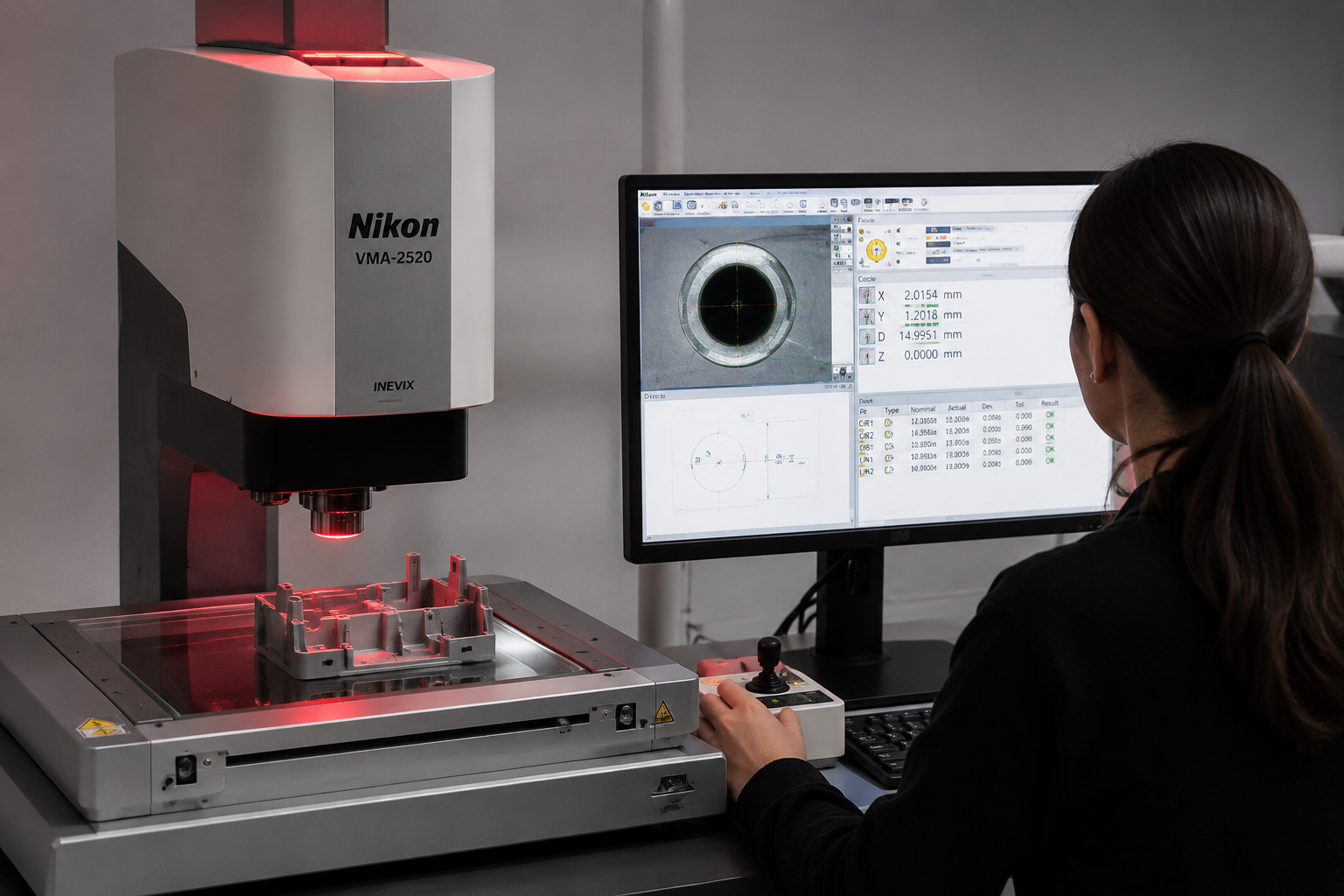
Preliminary Cpk: what it means and what it does not mean
Cpk measures process capability against specification limits. Many validation plans use Cpk >= 1.33 as a reference for critical characteristics, although the actual threshold depends on risk, customer requirements, applicable standards and the control plan.
Calculating Cpk on a prototype batch does not make that batch an official PQ. Formal PQ requires approved protocol, defined production conditions and statistical sample size. But preliminary Cpk can show whether a dimension is centred, whether dispersion is too high or whether the design is too close to the limit.
It is early information. In industrialisation, early information is worth more than late correction.
Arriving at PQ with data versus arriving without it
A team arriving at PQ with prototype data already knows which process window worked, which dimensions showed higher variability and which features need special monitoring. The control plan can be defined with fewer assumptions.
A team arriving without data discovers all of that during PQ: with the mould already built, deadlines committed and every iteration showing up in the project cost.
IQ/OQ/PQ validation does not really start at the production mould. The formal execution happens there, but risk reduction starts earlier: when you choose the material, geometry and process that will manufacture the part.
What to document from the prototype batch
For the prototype to support validation work, document at least:
- Exact material used for injection and material batch where applicable.
- Process parameters and machine conditions.
- Measurement plan with CTQs and acceptance criteria.
- Nominal-versus-actual dimensional report with deviations.
- Observations on filling, ejection, finish, flash and dimensional stability.
- Recommendations before production tooling: design, tolerance, gate or control-plan changes.
The question before production tooling: does IQ/OQ/PQ start in your company once the production mould is already built, or does the team arrive there with process data from injection-moulded prototypes?
Frequently asked questions about process validation
When should IQ/OQ/PQ start in a medical project?
Formal IQ applies to equipment, mould and production conditions. But the data supporting OQ and PQ can be anticipated in an injection-moulded prototype batch using the production material. Starting earlier reduces uncertainty in final tooling.
What minimum Cpk is required in medical injection moulding?
There is no single universal value for every project. Some projects use Cpk >= 1.33 as an internal or contractual criterion; other characteristics may require a different value. The applicable value must be defined in the validation plan.
Can Cpk be calculated on an injection-moulded prototype batch?
Only with a stable process, sufficiently independent observations, a suitable distribution and a justified sample can an exploratory Cpk estimate be calculated. It does not replace the official PQ, but it guides design and process decisions before committing to production tooling.
What is the difference between the prototype process report and the production process report?
The prototype report establishes an initial window using production material. The production report validates that window under production conditions with the final mould. The closer the prototype learning is to the final process, the lower the PQ deviation risk.