
Too few parts can leave key questions open. Too many parts turn a prototype into an expensive pre-series. The practical way to size a prototype batch is to start with the decision the project must take after measuring those parts.
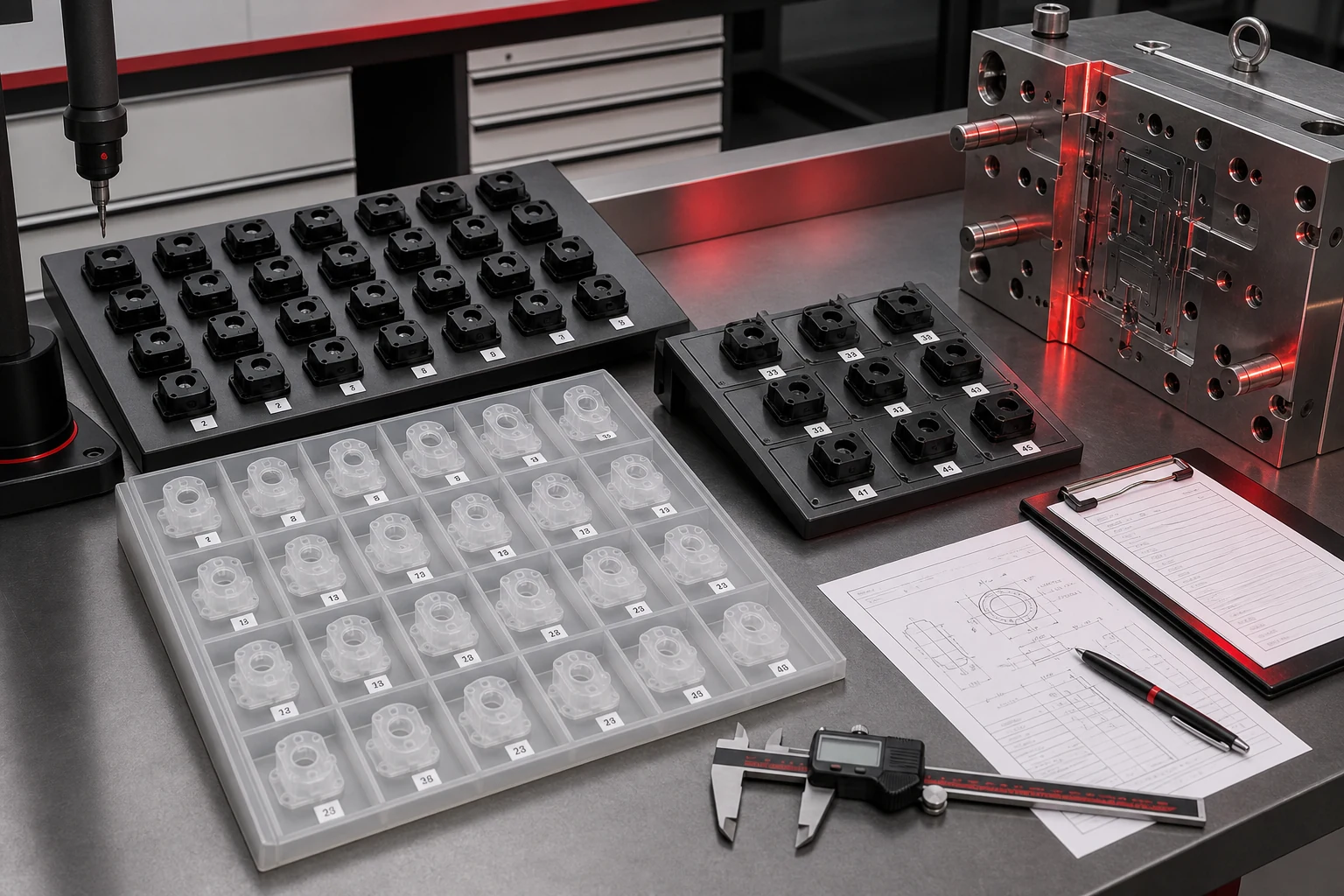
An injection-moulded prototype batch does not serve the same purpose in every project. Sometimes the objective is assembly and appearance. In other cases, the team must measure critical-to-quality characteristics (CTQs), run strength tests, observe dimensional stability after rest, compare materials or document an initial process window.
Practical rule: the minimum batch size is the number of parts needed to make a technical decision with enough evidence, not the lowest number that allows the machine to run.
Define the question first
Before discussing quantities, write the question the prototype must answer. If the question is “does it fit?”, the batch can be small. If the question is “what dimensional variation does this CTQ show under three process conditions?”, the batch must grow.
Three levels, three batch sizes
Initial validation: confirms fit, assembly, appearance or a design hypothesis. It may need few parts, provided variants, interfaces and necessary repeats are covered.
Functional validation: assigns parts to tests, CTQs, cycles, conditions and possible retain samples. The batch must cover the protocol without mixing test, measurement, customer and archive parts.
Process capability study: asks a different question. It requires a stable process, representative conditions and independent observations. NIST generally considers around 50 independent observations a large enough sample for estimating capability indices, but also notes that capability studies usually need n≥100. ISO 22514-3 does not consider its machine-performance-study method suitable below 30 observations; none of these values is a universal minimum for a prototype batch.
An additional automotive reference
In automotive manufacturing, PPAP is a specific production-part approval framework: it aims to demonstrate that a representative process, operating under production conditions, can consistently meet engineering requirements. It is useful where PPAP applies; it does not make PPAP or a particular batch size a universal requirement in other sectors.
How to calculate the batch
No standard table assigns a fixed number to each objective. The total should add the usable parts needed for every decision, the parts consumed by testing and a justified reserve. Start-up or purge parts must be identified separately and should not count as accepted samples until the process has reached the defined condition.
| Objective | Calculation basis | What it must cover |
|---|---|---|
| Fit, assembly and visual review | Units per assembly, variant and evaluator, plus repeats | Interfaces, interference, appearance and intended use |
| Dimensional measurement of CTQ | Sample calculated from expected variability, precision and confidence | Cavities, time sequence and critical characteristics |
| Functional or destructive tests | Protocol total, plus retain samples and reserves | Testing without exhausting parts assigned to measurement or archive |
| Material or process-condition comparison | Balanced repetitions for each variant | Compare options without confounding material, cavity, time and process |
| Capability or regulated validation | Approved statistical or validation plan | Stable process, representative conditions and acceptance criteria |
Why five parts are rarely enough
Five parts can support a quick review, but they provide very little information about variability. In injection moulding, start-up parts can be affected by thermal stabilisation, purging or initial adjustments. Machine manufacturers such as ARBURG explicitly separate start-up cycles from production settings until the process is running in a stable manner. Basing every decision on a minimal sample can confuse one conforming part with an understood process.
When the batch must grow
- When there are several cavities or repeatability between positions matters.
- When parts will be destroyed in mechanical, thermal or chemical tests.
- When CTQs have tight tolerances and dispersion must be assessed.
- When materials, colours, reinforcement percentages or process conditions are compared.
- When the customer requires documented evidence or a formal sampling plan.
The common error: mixing objectives
A single batch can disappear quickly if it is used for everything: assembly, photos, testing, customer samples, archive, dimensional measurement and retain samples. Good planning separates parts by destination: measurement, test, assembly, retention, customer and repeat checks if a result is doubtful.
What the batch should document
Beyond the number of parts, the team should record material, raw-material lot, injection parameters, cavity, production time, process condition and acceptance criteria. Without traceability, the batch can be useful for looking at parts, but weak for transferring learning to production tooling.
Frequently asked questions
Is there a mandatory minimum batch size?
Not universally. It must be justified by the objective, risk, expected variability, tests and customer or sector requirements.
Does a 30-part batch prove process capability?
No. It may provide preliminary information about trend and spread, but capability requires a stable process, enough independent data and representative production conditions. NIST notes that capability indices need large samples and that capability studies generally require more data than a short prototype run.
Should extra parts be produced?
Yes. Reserves should cover retain samples, additional tests, repeats and investigation of possible deviations.
Technical sources consulted
- FDA: Process Validation, General Principles and Practices
- NIST/SEMATECH: Process Capability
- ISO 22514-3:2020: machine performance studies and sample size
- AIAG: PPAP, automotive production-part approval framework
- ARBURG: controlled start-up and process stabilisation
These sources support the justification method, the need for process stability and statistical caution. They do not prescribe a universal prototype batch quantity.