
CTQs turn customer requirements into measurable dimensions, functions and criteria. An injected prototype can validate them before final tooling.
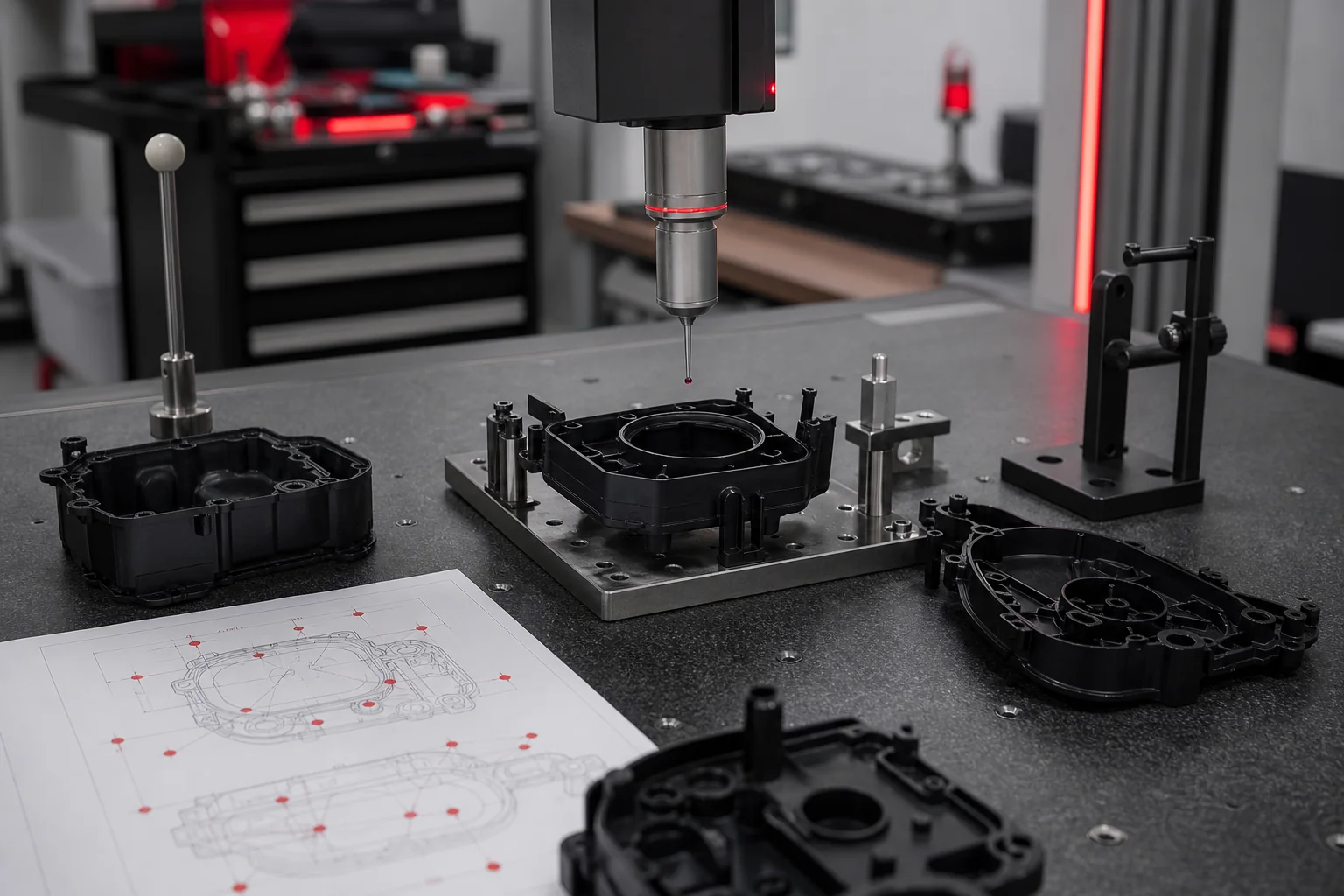
Not everything has the same weight
In a plastic part there are important dimensions and critical dimensions. CTQs are the characteristics directly connected to safety, function, assembly, sealing, appearance or customer satisfaction.
From requirement to measurement
A CTQ must translate a need into a measurable criterion: sealing diameter, support flatness, clip force, roughness, gasket position or maximum deformation after assembly. If it cannot be measured, it is not useful as a decision criterion.
Why define them in the prototype
If CTQs appear for the first time during series start-up, the project is already late. An injected prototype measures them with real material and process, detects sensitivity to variation and adjusts the control plan before final tooling.
Sample size matters
Not every CTQ needs the same number of parts. A geometric review may need few samples; a characteristic with process variation needs more parts to observe spread and trend.
From prototype to technical file
The value of the prototype is not only pass or fail. It is evidence: what was measured, against which criterion, which limits were accepted and what the production control plan must inherit.
Building a CTQ that supports a decision
A useful CTQ begins with the use requirement rather than an isolated dimension. For a sealed housing, the requirement may be to maintain closure after assembly, temperature exposure and ageing. That leads to measurable characteristics: gasket geometry, flatness, assembly force and deformation under the defined condition.
Each CTQ should record its unit, tolerance, measurement method, part condition, sample size and acceptance criterion. This prevents teams from comparing parts measured with different fixtures, at different process moments, or without separating cavities and material lots. The evidence remains traceable as the project moves from prototype to series production.
Separating part variation from measurement variation
Before concluding that a CTQ misses its target, the team must know whether the difference comes from the part or the measurement system. A calliper, functional fixture or scanning strategy with insufficient repeatability can hide a real trend or create a false alarm. The measurement process capability needs to suit the margin being controlled.
Designing the prototype lot
The lot is not designed merely to obtain good parts. It should include conditions that expose sensitivity: the start and end of the lot, reasonable process adjustments, cavities where applicable, and the representative material condition. It does not replace a production capability study, but it helps identify which CTQ needs process margin, a redesign or a clearer specification before final tooling is committed.
Turning the result into an industrial decision
Prototype closure should distinguish conforming CTQs, CTQs requiring follow-up and CTQs that block the next milestone. Each needs a verifiable action: adjust geometry, review the gate location, change the inspection fixture, or plan a larger sample. This connects design, quality and manufacturing without claiming a capability that the prototype cannot yet demonstrate.
Technical sources
Frequently asked questions about CTQ
What does CTQ mean?
CTQ means Critical to Quality: features critical to quality, function, safety, assembly, appearance or customer satisfaction.
Why define CTQs in the prototype?
Because it measures what is critical with real material and process before final tooling is committed.
Do all CTQs need the same sample size?
No. A geometric review may need few parts; a characteristic sensitive to variation needs more samples to observe spread and trend.