
In plastic injection moulding, few decisions look so small and have so many consequences as gate position. If it is validated too late, it can force steel modification. If it is tested at prototype stage, it becomes a documented technical decision before definitive tooling.
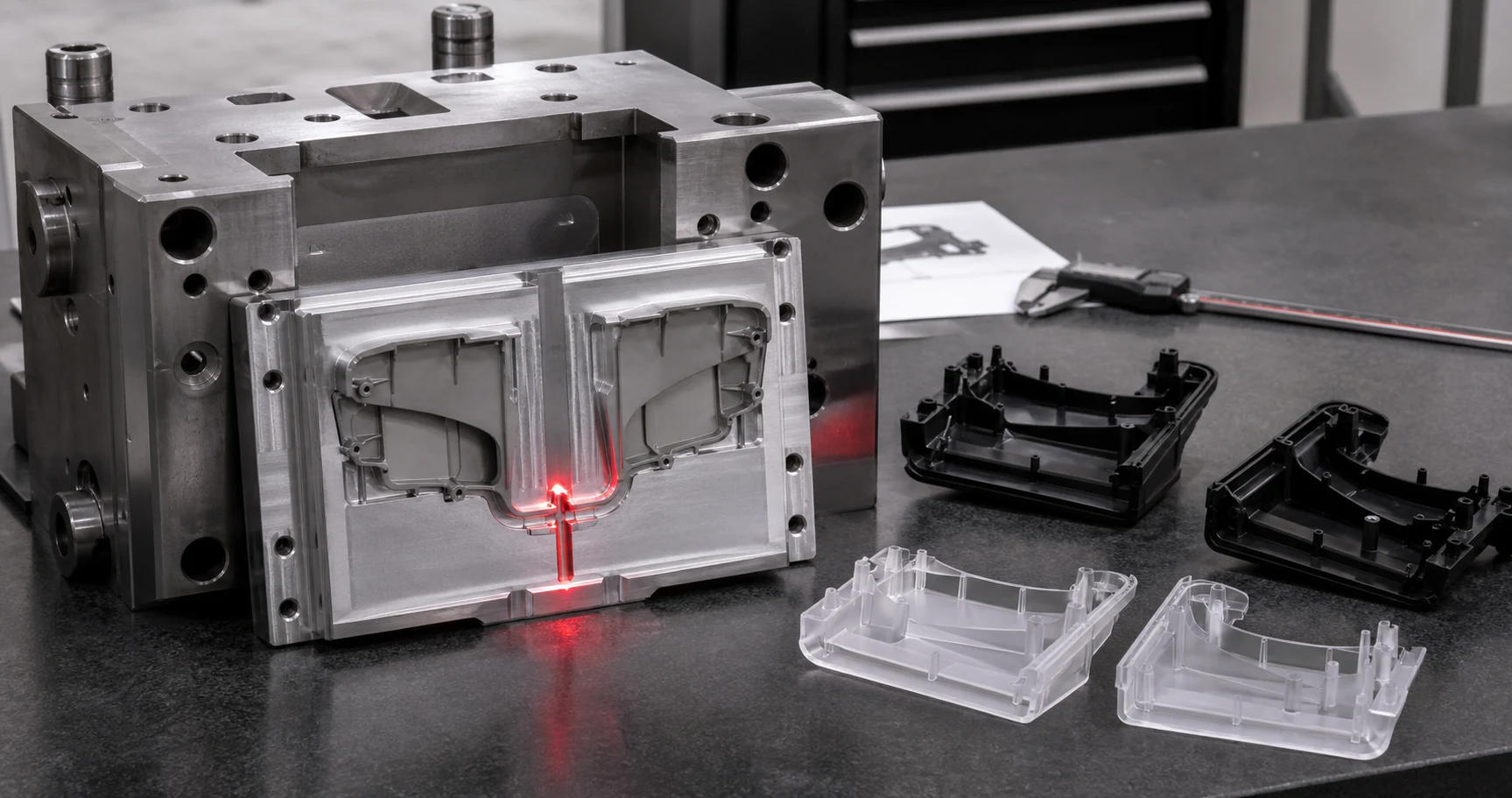
The gate is the entry point where molten plastic reaches the cavity. That definition sounds simple, but in practice it determines how the part fills, where the melt front cools first, which areas receive packing pressure more effectively and where defects such as weld lines, visible marks or dimensional deviation appear.
Key idea: a poor gate position detected in prototype can often be corrected through the insert when tooling architecture allows it. The same issue detected in production tooling usually means machining, welding steel, redesigning the feed system and repeating validation.
What gate position really defines
1. Flow path
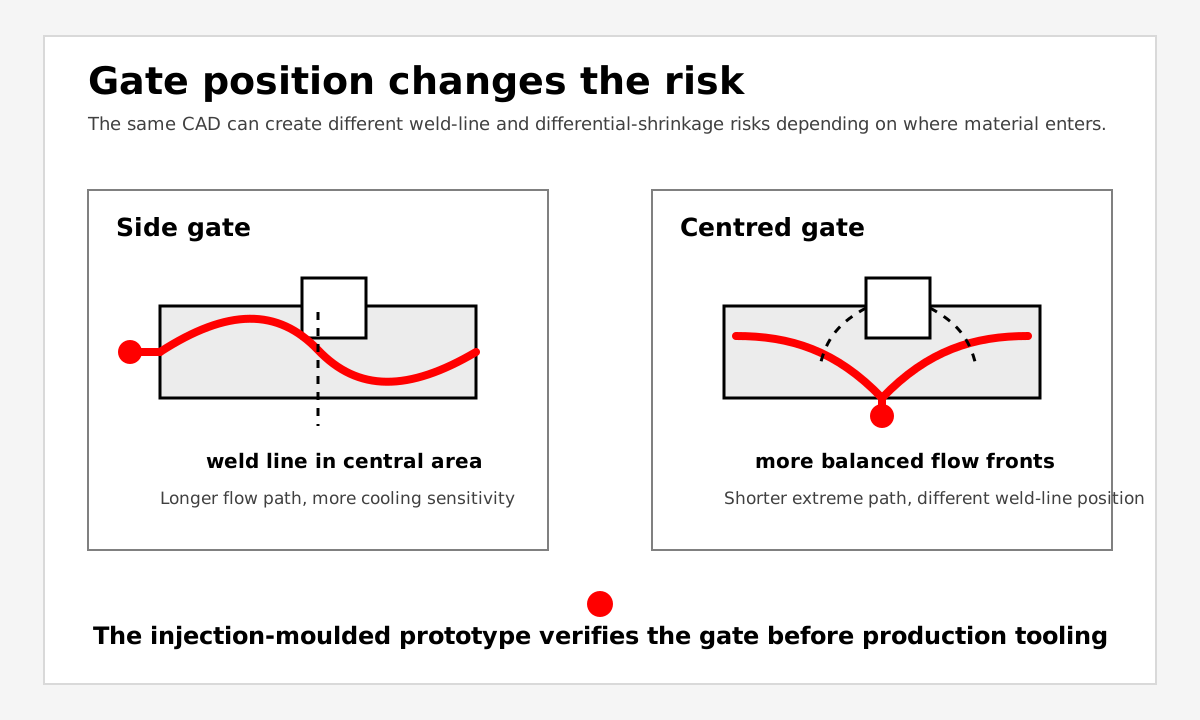
The farther the melt front has to travel, the more it cools before completing the cavity. This increases the risk of short shots, high pressure, flow marks and unfavourable fibre orientation in reinforced materials.
2. Weld lines
When flow splits around an obstacle and meets again, a weld line is formed. The gate cannot always remove that line, but it can move it. The difference between a weld line on a cosmetic area and one on a load-bearing area can decide whether the part is viable.
3. Packing and shrinkage
While the gate remains open, areas close to it usually receive holding pressure more effectively. Remote areas may pack less and shrink more. In long parts, ribbed parts or parts with wall-thickness transitions, that difference can create warpage or dimensional drift.
4. Gate mark and functional surface
Every gate leaves a trace or separation area. If that mark appears on a visible surface, sealing area, guide or assembly interface, the issue becomes functional rather than merely cosmetic.
Why CAD and simulation do not close the whole decision
Filling simulation is very useful for comparing gate alternatives before machining. It helps anticipate pressure, flow path, weld-line areas and air-trap risk. But simulation depends on model quality, material rheology data and real process conditions.
CAD, on the other hand, describes geometry only. It does not show how the melt front cools, how a remote area packs or whether a weld line reduces strength under real load.
What a P2P prototype mould can test
An industrialisable prototype mould can produce parts with production or equivalent material, real injection conditions and a representative feed configuration. If the first gate position creates a weld line in a critical area, the insert can be modified, if its design allows it, and the batch repeated before committing definitive tooling.
The advantage is not only economic. It is also documentary: the team reaches production tooling with a gate decision supported by prototype testing, supported by photos, measurements, process parameters and observed defects.
| Decision | If validated in prototype | If discovered in production tooling |
|---|---|---|
| Weld line in critical area | Modify gate or insert geometry | Rework steel and repeat samples |
| Visible gate mark | Test an alternative gate type | Modify feed system and revalidate finish |
| Differential shrinkage | Adjust packing, position or compensation | Correct tooling and dimensional plan |
Checklist before freezing gate position
- Is the weld line outside load, sealing or impact areas?
- Is the gate mark on an acceptable surface?
- Is flow length compatible with the material and wall thickness?
- Do remote areas pack sufficiently?
- Is the decision documented with injection-moulded parts and process parameters?
Frequently asked questions
Which gate type is best?
There is no universal choice. Pin, tunnel, side, film or hot runner gates have different advantages depending on geometry, appearance, ejection, pressure and allowed gate mark.
Can the gate be moved in a production mould?
Yes, but it is often expensive. It may require welding steel, machining a new entry, modifying runners and repeating validation.
Can simulation replace the prototype?
It should not be treated as a replacement. Simulation helps choose a hypothesis; the injected prototype checks it under the tested material and process conditions, and the final configuration must be confirmed in production.
Cross-checked official technical sources
- ISO 28238:2010 - Components and terminology for mould gating systems
- Celanese - Celcon POM processing guide
- BASF - Ultramid injection-moulding processing guidance
These sources support the general principles. Applicable acceptance criteria must be defined for the material grade, design, process, sector and agreed requirements.