
Using PCR can be a sound technical and environmental decision, but only if the project validates the real variability of the material that will run in the press.
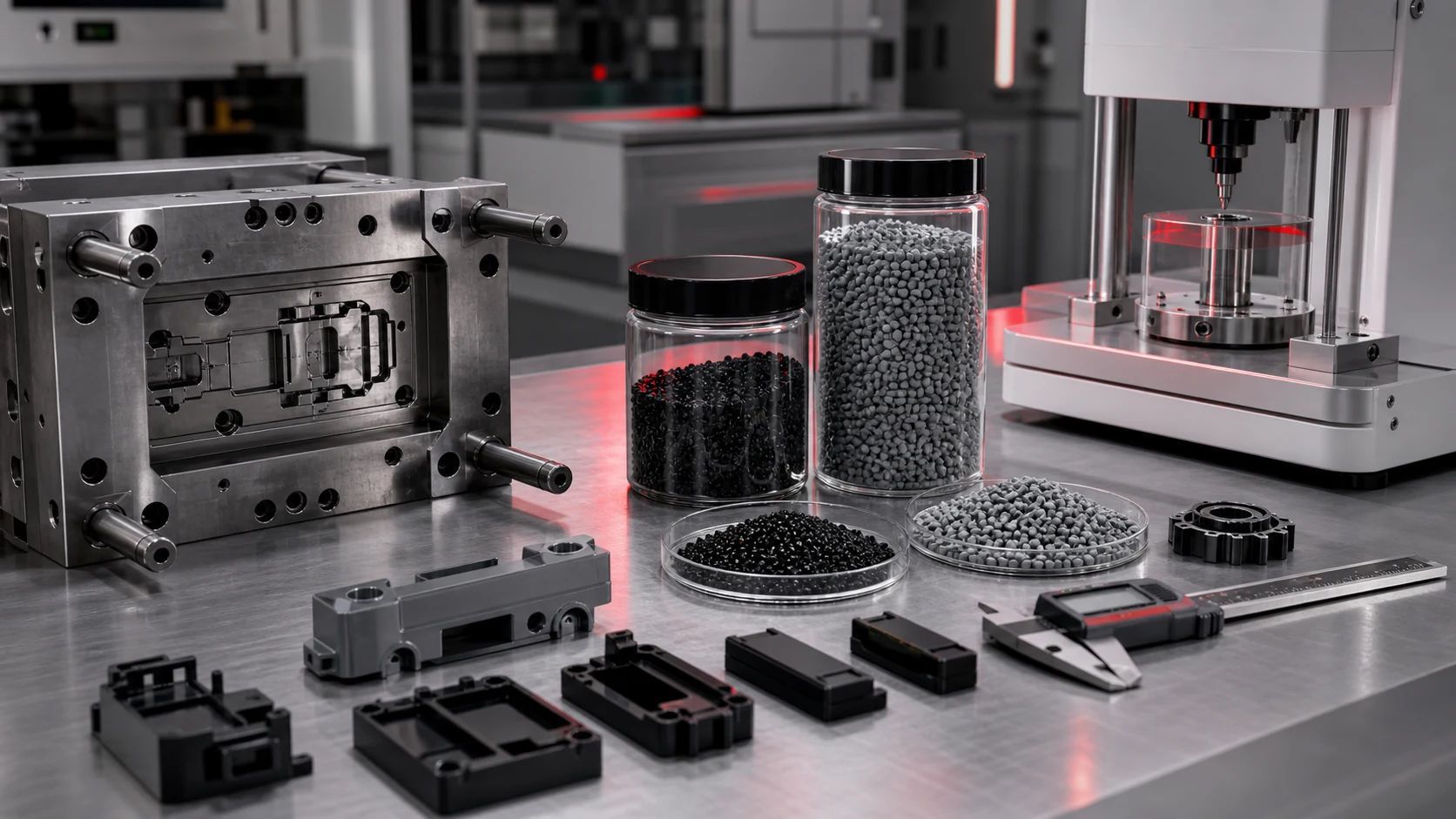
Key idea: PCR risk is not only the recycled percentage, but batch-to-batch dispersion and how that dispersion affects the moulded part.
PCR is not a property, it is a source
Two PCR batches with the same commercial name can have different thermal history, composition, moisture, colour, contamination or MFI. A datasheet approval is therefore not enough.
What variables should be checked
Review MFI/MFR, moisture, contamination, colour stability, odour, black specks, dimensional dispersion and minimum mechanical behaviour. Demanding applications may also require ageing or regulatory checks.
Why the prototype must use the real material
If production will mould PCR, validation with virgin material confirms something else. The prototype must show how the actual recycled material fills, packs, replicates texture and holds tolerances.
What to document for series
Supplier and lot, PCR percentage, available certificates, drying parameters, MFI/MFR, process conditions, observed defects, retained parts and acceptance criteria.
| PCR risk | What to observe in prototype |
|---|---|
| MFI/MFR variation | Filling, pressure, flash, short shots and process window |
| Contamination | Black specks, inclusions, odour and surface defects |
| Thermal degradation | Brittleness, colour, odour and property loss |
| Colour variability | Visual homogeneity and appearance acceptance |
Variability must be managed, not only detected
PCR should not be treated as one stable material just because it shares a commercial designation. Each incoming lot can differ in flow, moisture, colour, mineral content, contaminants or thermal history. First agree with the supplier which variables are controlled, at what frequency and what range represents the part.
MFR or MVR helps compare flow between lots, but it does not replace part validation. Record the incoming lot, declared PCR percentage, drying conditions and colour reference. Later deviations can then be investigated rather than generically attributed to “recycled material”.
How to adapt the process to different lots
An overly narrow process window may work with one sample and fail with the next lot. Prototyping makes it possible to deliberately widen temperature, speed and packing ranges and learn which variables affect filling, flow lines, gloss, warpage or shrinkage. If colour correction is needed, masterbatch and its dosage should be assessed with the same discipline as the base material.
Recommended minimum PCR protocol
- Define material family, supplier, source, PCR percentage and intended use.
- Record lot, receipt condition, colour and drying.
- Measure or request MFR/MVR data by lot where relevant.
- Test a reasonable temperature, speed and packing window, not one setting.
- Review appearance, filling, flash, black specks, shrinkage, dimensions and function.
- Compare several lots or a sample representing agreed variability.
- Document acceptance limits and industrial decision before production tooling.
PCR percentage does not scale linearly
Moving from 30% to 50% PCR is not simply increasing one variable. It may change the balance between flow, properties, appearance and material availability. The result depends on polymer, source, additives, geometry and functional requirement; validate the target percentage on the actual part rather than infer it from another product data sheet.
Regulatory context guides the technical question
For packaging, Regulation (EU) 2025/40 sets future post-consumer recycled-content targets by packaging type. In Spain, Law 7/2022 regulates the special tax on non-reusable plastic packaging. For food contact, Regulation (EU) 2022/1616 establishes a specific framework for recycled plastic materials and articles. These rules do not make a grade suitable by themselves: application, traceability and applicable evidence still need to be defined.
Frequently asked questions about PCR material
Why does PCR need specific validation?
PCR can vary in flow, moisture, colour, contamination and mechanical properties. That variability affects filling, finish, tolerances and process stability.
Is virgin material validation enough if series will use PCR?
Only as an initial reference. If series uses PCR, the prototype should test the intended recycled material or a representative sample of its variability.
What should be documented in a PCR prototype?
Supplier, batch, recycled content, drying, MFI/MFR, process parameters, observed defects and acceptance criteria.
Technical sources checked
- ISO 1133-1:2022 — determination of MFR and MVR of thermoplastics.
- EN 15343:2007 / UNE-EN 15343:2008 — traceability of plastics recycling and recycled-content assessment.
- ISO 15270:2008 — guidance on recovery and recycling of plastics waste; the ISO 15270-1 to -5 series is being progressively developed or published.
- Regulation (EU) 2025/40 — packaging and packaging waste.
- Regulation (EU) 2022/1616 — recycled plastic materials intended for food contact.